

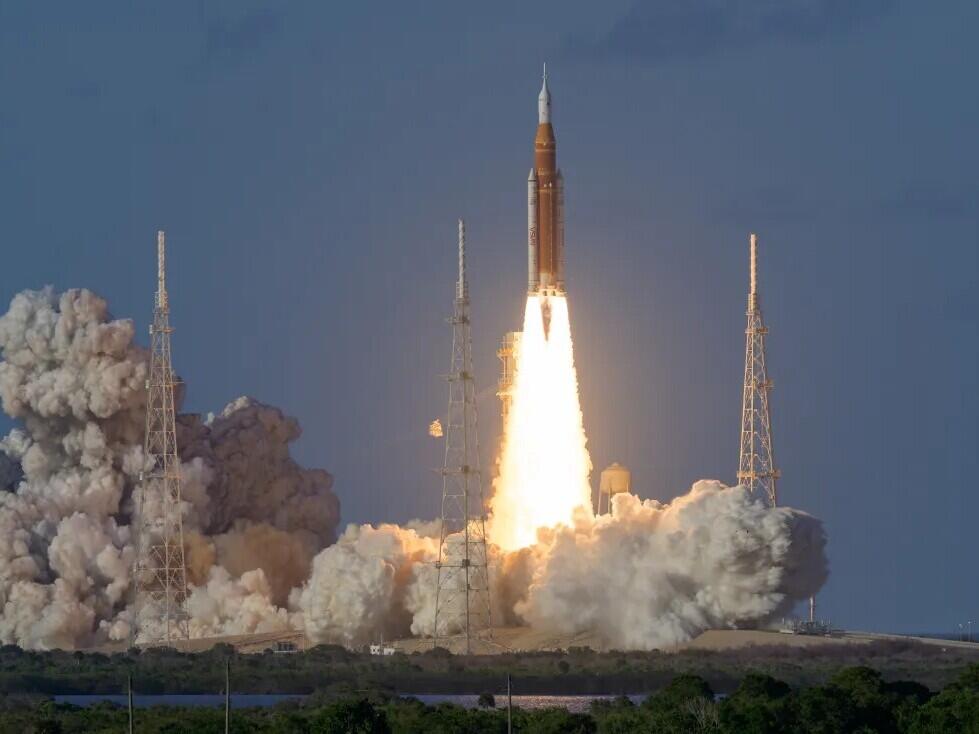
In a thunderous display of American resolve and ingenuity, NASA’s Artemis II mission is rewriting history this week as four astronauts aboard the Orion spacecraft loop around the Moon and race back toward Earth — the first humans to venture beyond low-Earth orbit in
more than five decades. Launched atop the mighty Space Launch System rocket from Kennedy Space Center on April 1, the crew has already smashed the Apollo 13 distance record, venturing farther from our home planet than any human beings before them.
This is more than a mission. It is America’s triumphant return to the Moon — a declaration that the United States remains the undisputed leader in human space exploration.
For the first time since Apollo 17 splashed down in December 1972, American astronauts are once again exploring cislunar space.
Commander Reid Wiseman, Pilot Victor Glover, Mission Specialist Christina Koch, and Canadian Space Agency astronaut Jeremy Hansen are conducting the critical test flight of the Orion spacecraft that will pave the way for sustained lunar presence and, ultimately, boots on Martian
soil. As the crew flew past the far side of the Moon on April 6, the world watched in awe as American technology carried humanity to new frontiers.
The achievement is especially sweet because it comes after years of doubt and delay. In 2011, the Obama administration retired the Space Shuttle fleet after 30 years of service, grounding America’s only means of launching astronauts into space. The decision left the United States dependent on Russian Soyuz rockets for nearly a decade — a humiliating gap that many feared would cede leadership in space to foreign powers.
Yet American innovation refused to stay grounded. Private American companies, led by SpaceX under the visionary leadership of
Elon Musk, stepped into the breach. Through NASA’s Commercial Crew and Commercial Resupply programs, SpaceX developed the Crew Dragon spacecraft, restoring U.S. crewed launch capability in 2020. Boeing followed with Starliner. These homegrown successes not only
ended America’s reliance on Russia but proved that bold public-private partnerships could achieve what government programs alone sometimes could not.
Today, that same spirit of American enterprise powers the Artemis program. While NASA’s powerful SLS rocket — the most powerful ever
built — provides the muscle to send Orion toward the Moon, private industry supplies the cutting-edge technology that will one day land
astronauts on the lunar surface.
The result? A new golden age of American spaceflight. Artemis II is not the end of a journey delayed by politics and budget battles — it
is the beginning of America’s permanent return as the dominant force beyond Earth. Future missions promise crewed landings by the late
2020s, a lunar Gateway station for sustained operations, and scientific outposts that will unlock the Moon’s resources for the benefit of all
humanity.
And then? Mars.
President Trump, who has made American space dominance a national priority, spoke directly with the Artemis II crew this week,
congratulating them on their record-breaking voyage and inviting them to the White House upon splashdown. His message was clear: America is back — and we are not stopping at the Moon.
As the Orion spacecraft hurtles homeward for a Pacific splashdown expected Friday, April 10, Americans everywhere can hold their heads
high. This mission proves that when the United States sets its sights on the stars, no challenge is too great, no record unbreakable, and no
dream too distant.
The stars and stripes fly again in deep space. The future belongs to those bold enough to seize it — and that future is unmistakably,
proudly American.