
Story by Thomas Fuller – Manatee Mysteries
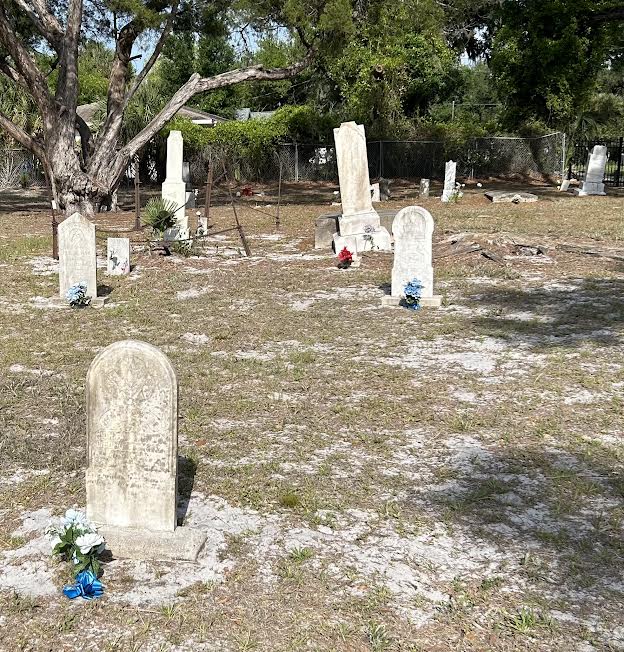
There is an old cemetery tucked away in Palmetto on the corner of 17th Avenue and 5th Street West. It doesn’t quite fit the neighborhood street layout, so 5th Street has to take an awkward swing to the south to keep motorists from driving through the place. It’s obviously old. Most markers have a pretty good tilt, are difficult to read and rather than resting in straight rows, look as though somehow they were dropped randomly from somewhere high up above and landed here and there. The reason may be due to the fact that only forty-four of the graves are marked among many others that are known to be there. The one acre property was donated by Samuel Sparks Lamb sometime before 1888 and remained in use until 1910. Officially, it’s the Old Palmetto Cemetery, but for those who know its sad history, they will tell you it’s the Yellow Fever Cemetery.
If you would decide to pay a visit sometime, after strolling through the gate and walking in a straight line toward the back, about halfway, just to the right, you will be able to find a humble granite stone, low to the ground, that simply reads, MARY S HOWZE 1844-1888. Hers was the first Yellow Fever death of the Palmetto Epidemic in the summer of the same year.
A short time before Mary’s death, her husband, Captain James A Howze, who operated a general store just to the west of the Lamb home on the Manatee River, had welcomed a salesman from Tampa who shared that he was not feeling well. Following the salesman’s return to Tampa, Captain Howze received word that he had died of Yellow Fever. Shortly after, Mary and her children fell victim to the mysterious illness. The children survived. Mary did not. Residents had to clear a road back to the graveyard in order to get her casket to her grave.
The epidemic raged in Palmetto to the extent that the town was quarantined until October. Previous epidemics had decimated populations. In 1793, the very first epidemic hit Philadelphia and ten per cent of the residents died. Many fled the city for their lives.
One of the most troubling symptoms of the disease was a coma-like state that resulted in many being buried alive. George Washington, who died in 1799, insisted that he not be buried for three days after he had been declared dead.
Nobody knew where it came from. Some thought immigrants were carrying it. Impure air and even Spanish moss were suspect. And treatments were often as bad as the illness.
Well, somebody did know where it came from, all the way back in 1886. After much study and investigation, Dr. Carlos Finlay became convinced that the disease was transmitted by a certain variety of mosquitoes. He prepared reports and presented his findings to a group of his medical colleagues, and what did they do? They laughed him out of the building. Yes, they laughed. Dr. Finlay returned to his homeland of Cuba to continue his studies and his research went ignored for twenty years.
Finally, the Spanish-American War came along and it was apparent that more American soldiers were dying of Yellow Fever than in battle. Dr. Walter Reed (yes, the guy they named the hospital after) was sent by the army to investigate, and working with Dr. Finlay, was able to demonstrate empirically that Yellow Fever was caused by the bite of a mosquito. The measures that followed to reduce mosquito populations and protect people were incredibly successful.
Even today, there is no cure for Yellow Fever, but very effective vaccines have been developed that can protect individuals for a lifetime, and measures can be taken to eliminate conditions that lead to high mosquito populations. None of these life- saving methods would be possible save for the ground-breaking discoveries of Dr. Finlay. I guess he had the last laugh.