
A stretch of water and mangrove islands that boaters quietly drift past and commuters along U.S. 19 only glimpse in passing is now at the center of one of the most consequential development conversations Tampa Bay has seen in generations.
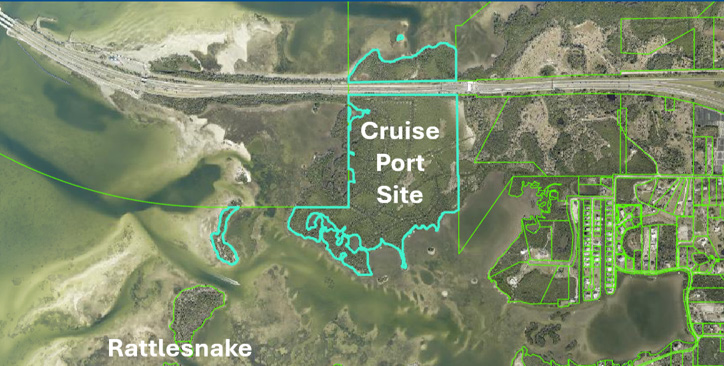
Rattlesnake Key, a roughly 710-acre undeveloped island near the Sunshine Skyway Bridge, was recently purchased for $18 million by a subsidiary of SSA Marine, one of North America’s largest cruise and port terminal operators. At the same time, SSA Marine and Tampa- based Slip Knott LLC unveiled early-stage conceptual plans for a new cruise homeport on approximately 328-acres know as the Knott-Cowen tract, located seaward of the Skyway. The proposal would allow larger, next-generation cruise ships that cannot clear the Skyway Bridge to operate locally, positioning Manatee County and West Central Florida as a major hub for modern cruise travel.
In recent weeks, public reaction to the proposal has grown quickly and visibly. Environmental groups and residents have launched petitions opposing the project, drawing thousands of signatures in a short period of time. At the same time, cruise travelers and tourism advocates have expressed strong enthusiasm, noting that ultra-modern cruise ships could soon be homeporting much closer, eliminating the long drive across the state to South Florida.
The conversation has rapidly spread across social media, community forums, and local news outlets, highlighting just how emotionally and economically significant this proposal has become.
From an economic development standpoint, the project is substantial. Developers project tens of thousands of new jobs, billions in regional economic activity, increased tourism spending, and long-term infrastructure investment. Florida’s cruise industry continues to expand rapidly, and ports across the state are competing aggressively to attract newer, cleaner, and larger vessels. A terminal located south of the Skyway would remove height restrictions and create new operational flexibility, potentially reshaping Tampa Bay’s role in global cruise travel.
At the same time, the environmental questions are complex and significant. Many residents are asking a reasonable question: Aren’t mangroves protected? The short answer is yes, but the longer answer is more complicated. Florida has some of the strongest mangrove protection laws in the country, yet regulatory frameworks also allow for mitigation strategies, environmental credit banking, habitat offsets, and compensatory restoration when impacts are deemed unavoidable.
In large-scale maritime and infrastructure projects, developers often work within overlapping federal, state, and regional permitting systems, where laws can be interpreted differently depending on project scope, location, and public benefit. Critics argue that mitigation credits and offsets can become legal workarounds that fail to replace what is lost, while supporters contend they allow for necessary economic development while funding large-scale environmental restoration elsewhere. This regulatory complexity is one of the reasons projects like this take years of environmental studies, public hearings, and agency review.
In short, the laws exist to protect sensitive ecosystems, but how they are applied can vary, which is precisely why this process is now under such intense scrutiny.
In response to public concern, SSA Marine has stated that it purchased Rattlesnake Key specifically to prevent commercial development and ensure permanent conservation of the island. According to the company, the acquisition is intended to preserve the key as a natural buffer and environmental safeguard adjacent to the proposed terminal site. While some see this as a positive step toward balancing development and conservation, others remain cautious, emphasizing that RATTLESNAKE to PAGE 2